You have a picture of a beautiful flower arrangement saved on your phone. You love the colors, the shape, and the way everything comes together.
There's just one problem: you couldn't name half the flowers in it.
Maybe you know what a rose looks like, but the smaller blooms, textured greenery, and unusual flowers are a mystery.
Here's the good news: You don't need to know flower names to order a custom arrangement.
A useful reference photo, a few color preferences, and some information about the occasion can tell a floral designer much more than a list of flower varieties.
Whether you're ordering birthday flowers, an anniversary bouquet, or something beautiful for your home, here's how to explain what you're looking for without needing a floral dictionary.
1. Start With What You Love About the Arrangement
When you find a floral design you like, don't worry about identifying every flower.
Instead, ask yourself what attracted you to the arrangement in the first place.
Was it the soft combination of pink and cream? The loose, garden-inspired shape? The contrast between large blooms and delicate smaller flowers?
These details help communicate the overall feeling you're hoping to achieve.
For example, compare these two requests:
"I'd like an arrangement with roses and some other flowers."
"I'd love something soft and romantic, mostly blush pink and ivory, with a natural garden-inspired shape and a few delicate flowers for texture."
The second request gives a designer a much clearer direction, even though it doesn't identify a single flower variety.
Try describing your ideal arrangement using three things: color, shape, and mood.
You might choose warm colors, a compact rounded shape, and a cheerful feeling. Or perhaps muted colors, an airy silhouette, and an elegant, understated look.
You don't need technical vocabulary. Everyday descriptions are often enough to start a useful conversation.
2. Use Reference Photos, but Explain What Matters
Pinterest, Instagram, and online flower shops can be wonderful sources of inspiration.
However, two people can look at the same arrangement and love completely different things about it.
One person might admire the peach roses. Another might love the flowing greenery. Someone else might simply appreciate the overall shape.
When sharing a reference photograph with a florist, explain which details matter most.
You could say:
"I love the colors and the loose shape of this bouquet. I'm flexible about the exact flowers, but I'd prefer to avoid bright yellow."
Or:
"I like how full this arrangement looks, especially the larger flowers in the center. I'd love something similar in lavender and white."
That extra explanation helps distinguish your preferences from the details that happen to appear in the photograph.
What if you have several inspiration photos?
That's perfectly fine.
Try choosing two or three photographs that show different aspects of your ideal arrangement.
For example:
Photo one: Your preferred colors.
Photo two: The shape and overall size.
Photo three: A container or presentation style you particularly like.
Explain what each image represents.
This is more useful than sending ten unrelated pictures and asking the designer to combine everything.
Remember that inspiration photographs are a starting point, not necessarily an exact blueprint. Flower varieties, colors, and containers may vary depending on availability.
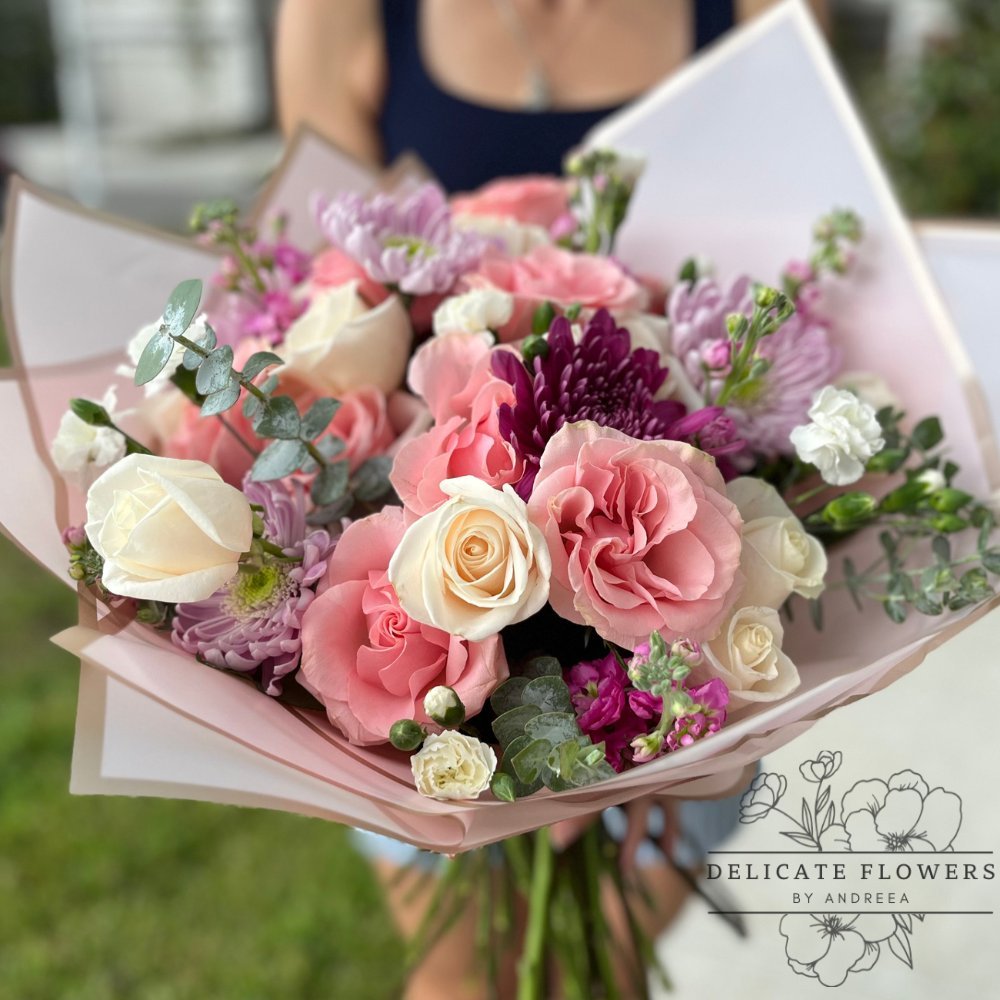
Blush Rose Reverie by Delicate Flowers by Andreea showcases how soft pink and ivory roses, vibrant purple blooms, and fresh eucalyptus come together in a romantic, garden-inspired bouquet, handcrafted in Wesley Chapel, Florida.
3. Think About Where the Flowers Will Go
A custom arrangement should suit its destination, not just look beautiful in a photograph.
Before ordering, consider how the flowers will be displayed.
For a dining table
A lower, wider arrangement may be more practical if people will be sitting across from one another.
You want the flowers to complement the setting without constantly interrupting conversation.
For an entryway or kitchen island
A taller arrangement can work well where there's enough space to appreciate it from different angles.
Consider whether the flowers will be viewed primarily from the front or from all sides.
For an office desk or bedside table
A compact arrangement may be easier to accommodate.
It's also worth considering the available surface space, nearby electronics, and whether the recipient will need to move the arrangement frequently.
For someone receiving flowers as a gift
If you're unsure about the recipient's home, describe what you do know.
Perhaps they enjoy minimalist décor, prefer neutral colors, or love cheerful, colorful spaces.
These clues can help guide the design without requiring you to guess which flowers they like.
4. Share Your Budget and Priorities Early
A custom arrangement doesn't have to mean an unlimited budget.
Sharing your intended spending range helps establish the scope of the design before specific flowers or containers are discussed.
Rather than simply asking for something impressive, explain what matters most to you.
For example:
"My budget is around $100. I'd prefer a smaller arrangement with a soft, elegant color palette rather than something large and colorful."
Or:
"I'm looking for a birthday arrangement around $150. I'd love something cheerful and full, and I'm flexible about the flower varieties."
These examples aren't price quotes or promises of what a florist can provide for those amounts. They're ways to communicate your priorities clearly.
If a particular flower, container, or design feature is essential, mention it before the order is confirmed.
Sometimes the most useful conversation is about deciding what to prioritize: the overall size, a particular color palette, a favorite flower, or a specific presentation style.
5. Know Which Details Are Flexible—and Which Aren't
One of the easiest ways to improve a custom flower order is to separate your must-haves from your preferences.
Imagine you want a romantic anniversary arrangement.
Your priorities might look like this:
Must-haves:
Soft pink and ivory color palette
No bright orange flowers
An arrangement suitable for a dining table
Flexible details:
Exact rose variety
Types of smaller accent flowers
Greenery selection
Minor differences in the overall shape
This gives the florist room to work with suitable materials while respecting what matters to you.
It also helps prevent misunderstandings.
At Delicate Flowers by Andreea, the published floral substitution policy explains that flower varieties and containers may change with availability while the overall style, color palette, and character of the arrangement are maintained.
If something must be included exactly as requested, discuss availability before placing your order.
For more information, read Will My Flower Arrangement Look Like the Photo?.
6. A Simple Message You Can Send to Your Florist
Not sure how to put everything together?
Here's a practical message you can adapt when requesting a custom arrangement:
"Hello! I'm interested in ordering a custom flower arrangement for a birthday.
I've attached two inspiration photos. I especially love the soft peach and blush colors in the first picture and the natural, rounded shape in the second.
My budget is approximately $125. The flowers will be displayed on a kitchen island, so I'd prefer something that looks beautiful from different sides.
I'm flexible about the exact flower varieties, but I'd like to avoid strong yellow or orange tones.
Could you let me know what's possible for my preferred delivery date?"
Notice what's missing: a long list of flower names.
Instead, the request gives the designer useful information about the occasion, colors, shape, budget, display location, and flexibility.
That's a much stronger starting point for a custom design.
Frequently Asked Questions
Can a florist create an arrangement from a Pinterest photo?
You can share a Pinterest image as inspiration, but don't assume the finished arrangement will be an exact reproduction. A florist can discuss which design elements are achievable, what materials may be available, and how to create an original arrangement that reflects the style you like.
What if I don't know which flowers are in the picture?
You can describe the colors, size, shape, and textures you like. If a particular bloom is important, ask the florist to help identify it and discuss availability.
Should I choose the flowers or let the florist decide?
Either approach can work. If you have favorite flowers, mention them. If you're more interested in the overall appearance, give the florist clear design preferences and flexibility to select suitable blooms.
Beautiful Flowers Begin With a Clear Idea, Not a Flower Dictionary
You don't need to be a floral expert to know what you find beautiful.
Perhaps it's a combination of soft colors, an unusual texture, or a natural arrangement that feels as though it belongs in a garden.
The more clearly you communicate those preferences, the easier it becomes to discuss a design that reflects your vision.
Delicate Flowers by Andreea creates handcrafted floral arrangements in Wesley Chapel, Florida, with delivery available in surrounding communities.
Have a flower inspiration photo but don't know how to describe it?
Contact Delicate Flowers by Andreea and share the colors, style, occasion, and budget you have in mind.
You don't need to know the names of the flowers. Start with what you love about them.